 |  Matthew has
very good reasons to be afraid. Before Jesus entered his life, he was a pariah
and an outcast of his people. As a tax collector recruited by the occupying
Roman forces, Matthew took money from his own people. Some say he extorted
their money, skimmed a portion off the top for himself, and then handed the
rest over to their bitter enemy, the Romans. And when he spontaneously left his
tax booth 3 years before, he had not asked permission from the Romans to
abandon his duties. Over these past years, it has been Jesus' physical Presence
that continuously guards his persistent dread of both his own kinsmen and the
deadly, capricious invaders. Now, with
Jesus' own words about His imminent departure, Matthew faces renewed
persecution by his people or arrest by the Romans. Without Jesus, Matthew is
going to be cast back into the repression meated out by his old life but without
the protection of the interlopers from Rome. He has every reason to fear. The room
becomes quiet, and Jesus, their Lord and Master, stands before them. Yet, at
that moment, Jesus begins to act in a manner well beneath His dignity and
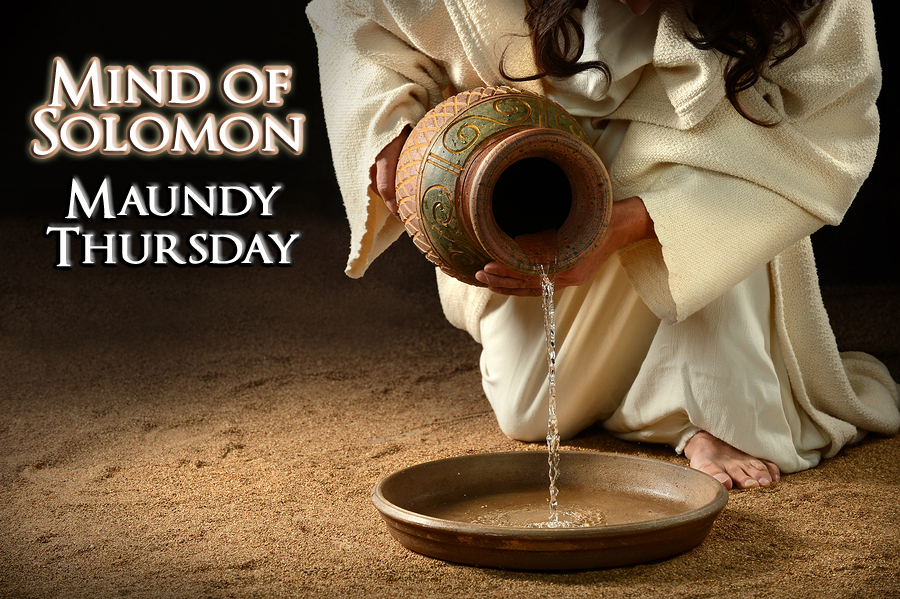
station as their Lord. Standing up from the table, Jesus removes
His outer robe, takes a servant's towel, and ties it around His waist. (John
13:4) For three years, Matthew has witnessed unspeakably profound miracles,
from the raising of the dead to impossible healings of the blind, the lame, and
the deathly sick. Jesus never spoke or did anything that even closely resembled
common or ordinary. And now, Matthew is witnessing yet another of Jesus' most
unusual actions. In but a moment, their honored Rabbi, Jesus, is taking on the
dress, appearance, and actions of a common house slave right before their
astonished eyes. Matthew could not be more confused or unsettled by Jesus' actions.
That is until his Lord and Master begins to do the wildly unacceptable and
wholly unthinkable. Jesus actually kneels before and begins to wash the feet of
the disciple nearest him – a task reserved for the least in any Jewish household. Matthew is immediately and reflexively filled with revulsion. While
he deeply loves Jesus and respects Him more than anyone on Earth, no master or
patriarch of any Jewish family would ever demean their station by this
act reserved only for the lowest of slaves. Matthew glances around him at the
faces of the other disciples and at the one sitting next to him who Jesus is
about to encounter – Simon, the
son of Jonah. It was Jesus Who renamed Simon Cephas, or Peter, the rock, years
earlier. Peter's face is already bright red, his visage as hard as the stone after
which he had been named. Matthew is certain that Peter will never abide
this insult that Jesus was bringing on Himself. And he is not disappointed. Jesus
takes but a single step toward Peter, and Matthew's well-informed guess of the
response of the most impulsive among them bears immediate fruit. "He (Peter) said to Him, 'Lord, You are washing my feet?'" "Jesus answered and said to him, 'What I am doing, you do not realize right now, but you will understand
later.'” “Peter said to Him, ‘Never shall You wash my feet!’” “Jesus answered him, ‘If I do not wash you,
you have no place with Me.’” “Simon Peter said to Him, ‘Lord, then wash not only my
feet, but also my hands and my head!’” (John 13:6-9) Matthew looks at Peter’s face as Jesus kneels before him and begins
to wash his feet. Tears are flowing down Peter’s cheeks and dripping off his
beard. As Matthew witnesses this most extraordinary behavior of his Master,
he begins to anticipate that he is next in line to receive the washing of his
own feet by Jesus. And, in but a moment, Jesus stands, steps over, and kneels. Matthew
wills his confused, fearful, shame-filled gaze to look outward as Jesus stoops
before him, dressed as a slave and holding the pitcher and towel of a common servant,
and Jesus’ eyes connect with his as He kneels there. To Matthew, time slows to a stop as Jesus' eyes meet his, just a
handful of inches away. As Matthew, the outcast tax collector and fugitive from the Roman
occupiers looks into the face of his Lord and Creator, all that he discerns is
a fathomless, incomprehensible love. It is infinite in its extent – a purity as
absolute as he has ever known. And, at that moment, his face relaxes. His fear is
suddenly gone. His worry has vanished like a snowflake before the summer sun. At
that instant, Matthew knows a supernatural Peace that will follow him all the
way to his martyr's death. Never again will he forget the eyes of Jesus and the
Peace that silently and wordlessly erases his fear. Matthew blinks the fresh tears away as Jesus kneels before him. Here
is the King of kings and Lord of lords washing and wiping the filth of Jerusalem
off of his skin – the skin of a traitor, the flesh of a failed, duplicitous son
of Israel. Suddenly, Mathew’s tears transform into a quiet sob. The grace of
Christ floods his life and overcomes his soul like a great rogue wave from
heaven. It encompasses him round about and draws him irresistibly along as it
covers, anoints, cleanses, and heals him forever. He knows at that moment that
Matthew the traitor, Matthew the pariah of his people, is forever gone. Now, he
is a son of the Most High God, forgiven and fashioned into a new creation by
the hands of the One Who formed the stars. The old traitor, pariah, and outcast
that they had called Matthew Levi, son of Alphaeus, was no longer among
them. The feeling of his Lord’s hand caressing and cleaning his flesh is eternally imprinted on his mind and heart. And by this extraordinary act of unthinkable humility modeled by His Lord, Matthew knows what the next three decades of his own life hold. He is to become the servant of all – the house slave of his people. For in this act of obedience, he will arise from this upper room knowing that his destiny will become one with ten of his other friends and disciples. In but a handful of hours, they will witness the death of these Hands that care so much for them. Yet these Hands and the Body of Jesus will likewise arise from death, walk out of a tomb that can never hold Him, and change the eternal destiny of every living creature. All because the Greatest became the least. And, on the very next day, Jesus will spend His precious life for the unworthy, the outcast, the pariah, and the hopeless in the most amazing act of grace the Earth and all of its inhabitants will ever know! -------------- "The name “Maundy” comes from the first word of the Latin phrase “Mandatum novum do vobis ut diligatis invicem sicut dilexi vos” -(“A new command I give you: Love one another. As I have loved you, so you must love one another”) (John 13:34). -------------- Dennis and Claudia Chamberland |